project
Country Collaboration Prediction
A graph machine-learning study using GDELT event data and temporal country-interaction networks to predict cooperative relationships between countries.
Country Collaboration Prediction is a graph machine-learning project that uses GDELT event records to model country interactions over time and predict whether country pairs are likely to show cooperative relationships.
The dataset is represented as monthly country-interaction graphs. Countries are nodes, and edges are built from GDELT events where two countries appear as actors. Edge weights combine the Goldstein scale, event tone, number of mentions, and number of articles attached to the events.
Approach
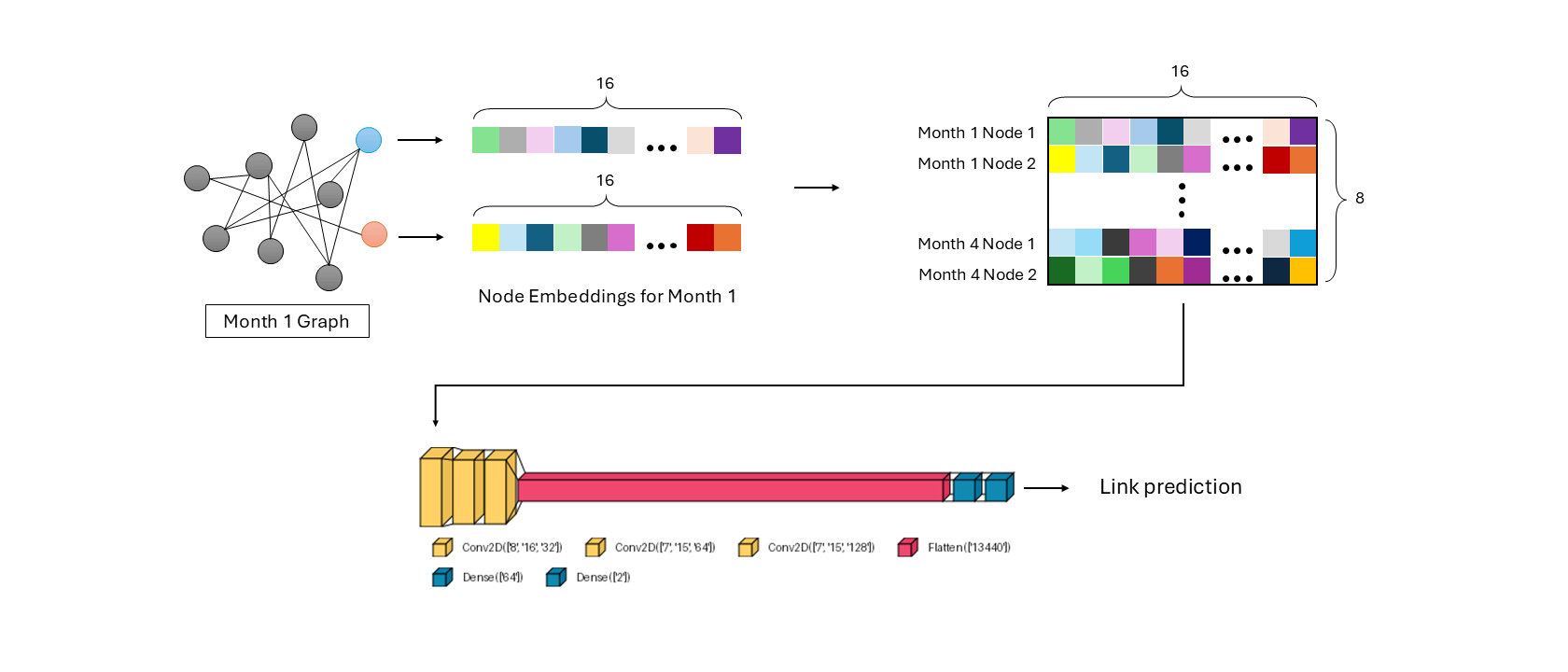
The experiments use four months of graph history to predict cooperation in a fifth month. Node2Vec embeddings provide the country representations, and the project compares several link-prediction strategies:
- dot products of averaged country embeddings;
- dot products scaled by random-walk co-occurrence frequency;
- cosine similarity between averaged embeddings;
- random-forest classification over concatenated country vectors;
- a CNN classifier that treats the previous-month embeddings for a country pair as an image-like input.
Results
The CNN-based link-prediction model was the strongest method in the reported experiments. On the training period, it reached 0.79 accuracy and 0.80 F1. On newer evaluated months, it averaged 0.758 accuracy and 0.779 F1, outperforming the other tested approaches on the main reported metrics.
The paper also checks whether the model predicts real cooperation examples from November 2023, including Ukraine-related cooperation with the United States, Germany, and Finland.
Takeaway
The useful part of the project is the comparison between simple embedding similarity features and a model that preserves more of the temporal structure of the country-pair embeddings. The CNN approach performed best because it kept the four-month embedding sequence visible to the classifier instead of collapsing it too early into a single score.