project
2D Autonomous Driving
A reinforcement-learning comparison of PPO, A2C, and QRDQN agents trained to navigate simulated highway and merge environments.
This project compares PPO, A2C, and QRDQN reinforcement-learning agents in
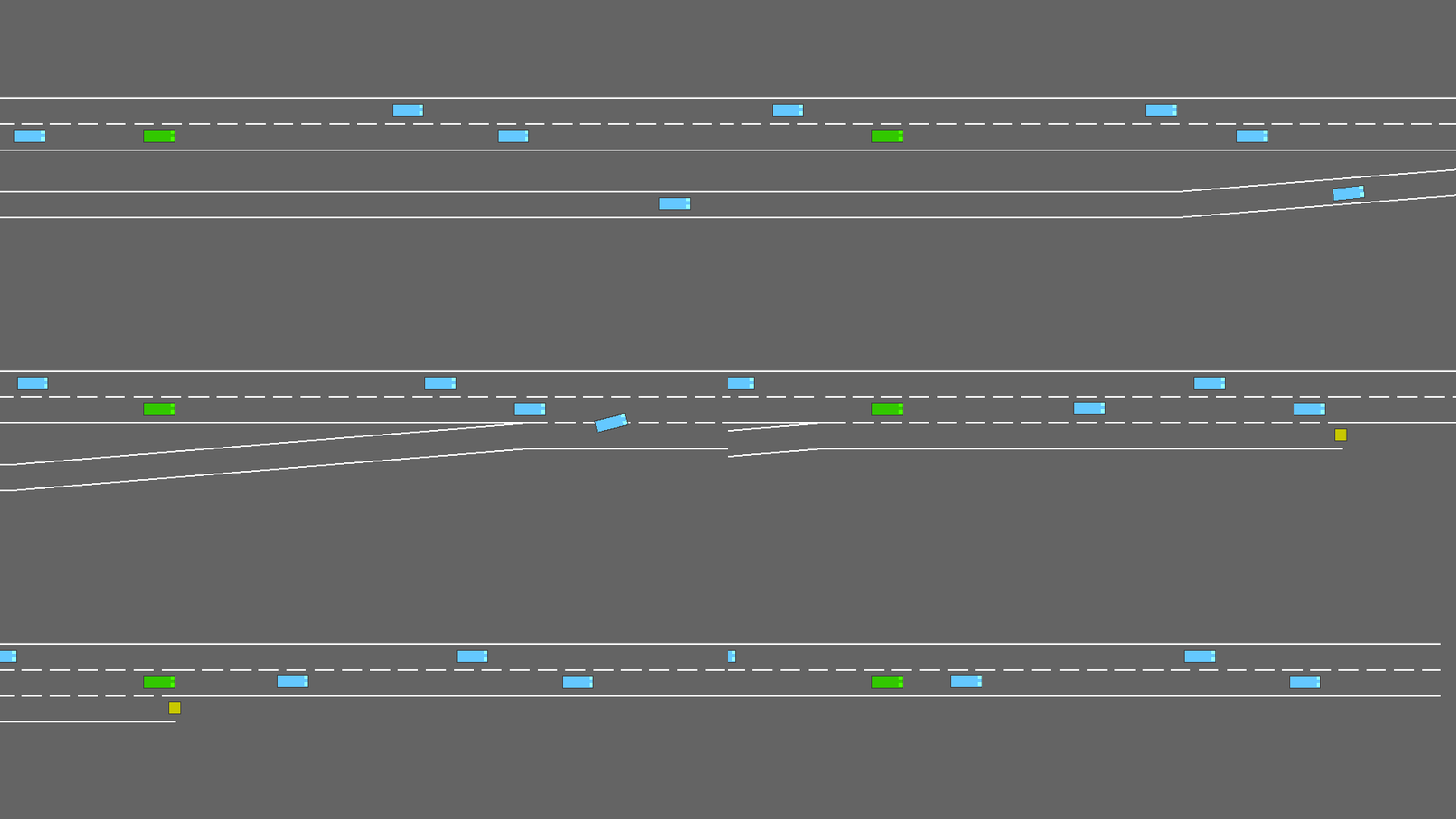
highway-env, using simulated highway and merge driving tasks to test both
baseline behavior and the effect of hyperparameter optimization.
The goal was to see how the agents performed when trained and evaluated in the same driving environment, and how well that performance transferred when the test environment introduced merging traffic.
Setup
I tested three configurations:
- Configuration A: train on
default-fast, test ondefault. - Configuration B: train on
default-fast, test onmerge. - Configuration C: train on
merge, test onmerge.
Each algorithm used the Stable-Baselines3 implementation with the default
CnnPolicy and grayscale observations from highway-env. Training runs used
100,000 learning steps and 20 evaluation trials. Hyperparameter optimization
used Bayesian optimization over learning rate, discount factor, and RMSProp for
A2C, with each tuning trial trained for 50,000 timesteps and evaluated over 10
trials.
Results
Before tuning, all models handled the straight highway task better than the merge transfer task. A2C was the strongest baseline in configuration A and also held up best when tested on merge after training on the default environment.
After hyperparameter optimization, configuration A improved substantially:
| Algorithm | Before HPO | After HPO | |---|---:|---:| | A2C | 42.9 | 56.64 | | PPO | 30.92 | 48.46 | | QRDQN | 31.94 | 56.46 |
QRDQN improved the most in configuration A, reaching nearly the same final reward as A2C after tuning. PPO also improved strongly. A2C improved less by percentage, but started from the strongest baseline.
Configuration B moved in the opposite direction:
| Algorithm | Before HPO | After HPO | |---|---:|---:| | A2C | 29.51 | 29.01 | | PPO | 21.54 | 13.21 | | QRDQN | 19.55 | 11.66 |
For the merge transfer task, tuning did not improve the tested agents. A2C remained roughly stable, while PPO and QRDQN both declined after optimization.
Takeaway
The main result is that hyperparameter optimization helped in the environment it was tuned around, but did not transfer cleanly to the more dynamic merge test. Configuration A showed large gains after tuning, especially for QRDQN. In configuration B, the tuned policies were less robust, which suggests the tuning process was strongly environment-dependent.
The next useful step would be a fuller optimization pass for configuration C, where the agents are trained and tested directly in the merge environment.